By Austin Beaty, Founder and CEO, Austin Lane Technologies
ERP vendors in construction have been reducing their investment in payroll for years. Some have spun it off. Some have partnered it out. Some have quietly stopped developing it. The reason is the same across the board: job cost payroll in construction is a highly specialized function with significant compliance and regulatory complexity, and most ERP vendors have decided it is not worth maintaining internally.
This changes the architecture of how construction companies run their back office, and it creates a gap that is harder to fill than it looks.
The Old Promise Is Gone
For years, ERP vendors sold the vision of one system, one database, one vendor, one number to call. Customers liked the simplicity. No finger-pointing between vendors. Everything in one place. That model worked when the ERP actually covered everything, including payroll.
Today, that pitch has changed. ERP vendors now position themselves as the hub of an integrated ecosystem. You still have one strategic platform for job costing, project management, and financials. But payroll, HR, and time capture are handled by specialized applications that connect to the hub. This is the hub-and-spoke model, and it is how most construction technology stacks are being rebuilt right now.
The HCM Bundle Problem
When the ERP drops payroll, someone has to pick it up. Large HCM vendors have moved aggressively into this space, offering payroll as part of a bundled HR deal. On paper, it sounds efficient. One vendor for HR, benefits, and payroll.
The problem is that these vendors came from the world of department-based costing. Their payroll is built for office employees: one person, one department, one pay rate, one entry. Construction payroll is a different animal. Union rules. Certified payroll reporting for government contracts. Prevailing wage compliance. Employees who work across multiple jobs, cost codes, and pay rates in a single day. When an HCM vendor tells you they handle construction payroll, ask them how they handle a concrete crew that works two Davis-Bacon jobs before lunch.
We see this play out with our own customers. An HCM vendor sells time and payroll as part of a bundle. HR goes live without issues. Then the payroll implementation starts getting delayed because certified payroll and union rules are more complex than the vendor expected. Meanwhile, the field crews still need to enter time, and the HCM time module was designed for someone sitting at a desk, not a foreman entering time for a ten-person crew across three cost codes on a phone with no cell service.

PE-Backed Payroll Vendors Are Adding Noise
On top of the HCM bundlers, there is a growing wave of private equity-backed HR and payroll startups entering the market. They appear almost daily, well-funded and well-marketed, targeting the gap that ERPs left behind. Some of them are building real products. Many of them are assembling acquired pieces that have never been tested in a construction environment. If your payroll has union classifications, certified reporting, and multi-state compliance, vet these vendors carefully.
The API Gap in Legacy ERPs
The hub-and-spoke model only works if the hub and the spokes can actually talk to each other. Many of the legacy ERPs that construction runs on, Vista, Spectrum, Sage 300, were developed before modern API technology. Their integration options are often limited to flat file imports, ODBC connections, or middleware layers that require constant maintenance. That is a real constraint when you are trying to get field data into job costing and payroll in real time.
Where ALMobile Fits
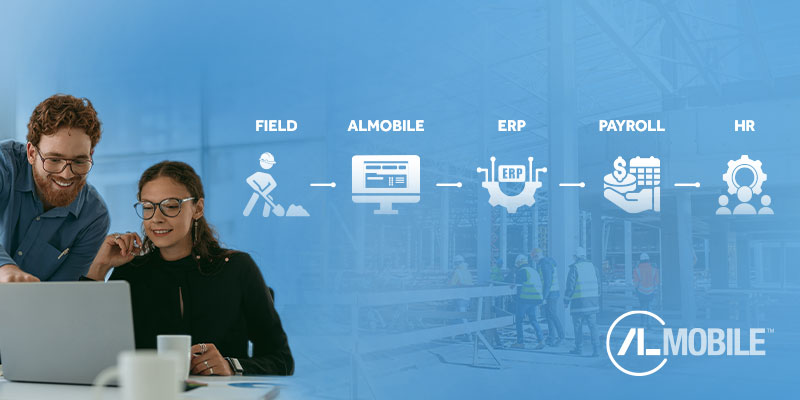
ALMobile was built for exactly this gap. We are not an ERP. We are not an HCM. We are the operational platform that captures jobsite intelligence, time, attendance, production, and equipment data, at the point of work and connects it to both sides of the back office.
The V13 API portal is how that connection works. It pulls job and equipment data from the ERP so field entries are validated against real cost codes and work orders. It pushes time and labor data to the HCM or payroll system so pay processing starts with clean data. It does this through documented APIs and direct-connect integrations, not CSV exports and not middleware that breaks when someone changes a cost code structure.
The part that matters most, and the part that HCM vendors consistently underestimate, is how time gets captured in the field. Construction time entry is not one person, one department, one entry. It is a foreman entering time for an entire crew across multiple jobs, cost codes, and equipment in a single session. It is superintendents reviewing and approving in the field before the data ever reaches the office. It is offline capability on a jobsite with no connectivity. ALMobile was built around that workflow because it is the only workflow that actually works in construction.
Completing the Ecosystem
The hub-and-spoke model is the right architecture for construction technology. The ERP stays at the center for job costing and financials. Specialized vendors handle payroll, HR, and the functions that require deep domain expertise. But the model has a hole in it if nobody owns the field data layer. That is what ALMobile does. We capture the data where the work happens and deliver it to every system that needs it, accurately and on time.
If your ERP has dropped payroll, or if you are evaluating an HCM to take over that function, the question to ask is who handles field time capture. The HCM will tell you they do. Ask them to show you crew-based entry for a union contractor on a certified job. That conversation tends to clarify things quickly.